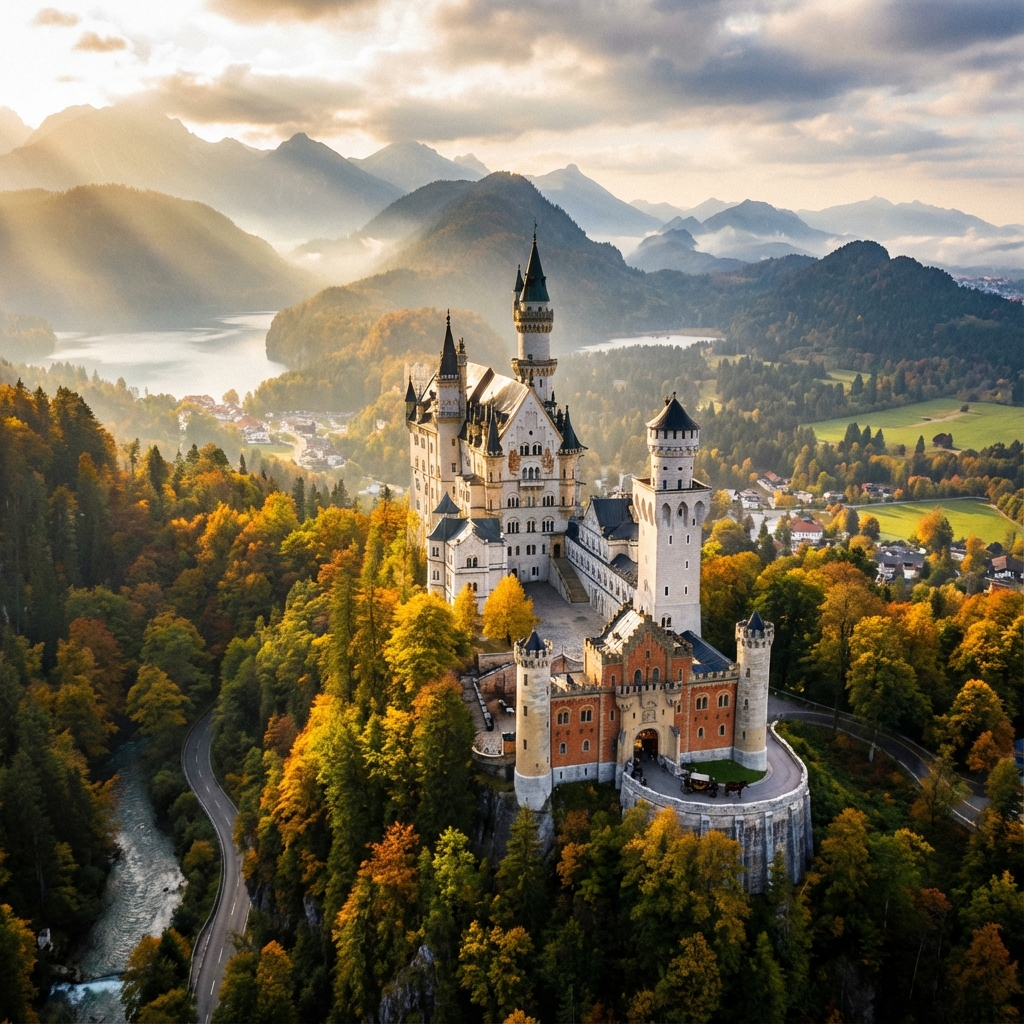
Europe is a continent woven with history, myths, and legends, and nowhere is this more evident than in its thousands of majestic castles. From rugged medieval fortresses designed to withstand sieges to romantic 19th-century palaces built for kings who preferred dreaming to ruling, these structures capture the imagination like nothing else.
In this comprehensive guide, we journey across the continent to explore the top 5 most magical castles you absolutely must visit. Whether you are a history buff, an architecture enthusiast, or simply looking for your next fairytale profile picture, these destinations promise an unforgettable experience.
1. Neuschwanstein Castle, Germany
Location: Bavaria, Germany
Style: Romanesque Revival
Year Built: 1869
It is arguably the most famous castle in the world. Neuschwanstein Castle isn’t just a building; it’s the physical embodiment of the term “fairytale.” Commissioned by the reclusive King Ludwig II of Bavaria, it was intended as a private refuge where he could withdraw from public life and immerse himself in the world of Richard Wagner’s operas.
A Brief History
Construction began in 1869, but the castle was never fully completed. King Ludwig II only spent 11 nights in the castle before his mysterious death in 1886. Ironically, the castle built for a shy king who sought solitude was opened to the paying public just weeks after he died. Today, it stands as a monument to his romantic vision and is widely known as the inspiration for Disney’s Sleeping Beauty Castle.
How to Get There
The closest transport hub is Munich. From Munich, you can take a 2-hour train ride to Füssen. From the Füssen train station, a local bus will take you to the village of Hohenschwangau, which sits at the foot of the castle. From there, you can hike up (about 30-40 minutes), take a shuttle bus, or ride a horse-drawn carriage.
Best Time to Visit
- Shoulder Season (May or September): You get decent weather but avoid the peak summer crowds.
- Winter: For a truly magical snow-covered experience, visit in January or February. However, be aware that the bridge (Marienbrücke) offering the best view might be closed due to ice.
Did You Know? Despite its medieval look, Neuschwanstein was packed with cutting-edge technology for its time, including central heating, running warm water, and even an electric bell system for summoning servants.
2. Mont Saint-Michel, France
Location: Normandy, France
Style: Gothic / Romanesque
Year Built: 8th Century (Origins)
Rising from the sea like a mirage, Mont Saint-Michel is one of France’s most stunning sights. Technically an abbey rather than a traditional royal residence, its military fortifications and position on a rocky tidal island make it one of the most impregnable fortresses in history.
A Brief History
The site has been a place of worship since the 8th century after the Bishop of Avranches claimed he was visited by Archangel Michael. During the Hundred Years’ War, the abbey was fortified and successfully withstood a 30-year siege by the English. In the 19th century, before it was restored as a national monument, it paradoxically served as a prison.
How to Get There
You can take a TGV train from Paris (Montparnasse) to Rennes or Dol-de-Bretagne, then transfer to a coach bus that takes you directly to Mont Saint-Michel. The journey takes roughly 3 to 4 hours.
Best Time to Visit
To see the “island” effect, you must visit during a high spring tide, which occurs roughly every two weeks. Arrive early in the morning (before 9 AM) or late in the afternoon (after 4 PM) to avoid the massive tour bus crowds.
Did You Know? The tide here is infamous. It is said to “rush in as fast as a galloping horse.” While that is an exaggeration, it does rise extraordinarily quickly, trapping unwary tourists on the sands surrounding the mount!
3. Alcázar of Segovia, Spain
Location: Segovia, Spain
Style: Gothic / Herrerian
Year Built: 12th Century
Located roughly an hour north of Madrid, the Alcázar of Segovia cuts a striking silhouette. Rising out of a rocky crag shaped like the bow of a ship, it commands the confluence of two rivers. It is one of the most distinctive medieval castles in Europe and another rumored inspiration for Disney’s Cinderella Castle.
A Brief History
Originally built as a fortress, it has served as a royal palace, a state prison, a Royal Artillery College, and a military academy. It was a favorite residence of the monarchs of Castile in the Middle Ages and a key site for the coronation of Queen Isabella I, one of Spain’s most powerful rulers.
How to Get There
Take a high-speed AVANT train from Madrid (Chamartín) to Segovia-Guiomar. The trip takes only 30 minutes! From the station, catch a local bus or taxi to the old town and the aqueduct, then walk through the historic city to the castle.
Best Time to Visit
Spring and Autumn offer pleasant temperatures for walking around the castle grounds. The view from the Tower of Juan II is spectacular but requires climbing 152 steps—best done when it isn’t scorching hot.
Did You Know? A devastating fire in 1862 destroyed much of the roof, but it was lovingly restored to its original style, giving us the slate spires we see today.
4. Château de Chambord, France
Location: Loir-et-Cher, France
Style: French Renaissance
Year Built: 1519
The largest château in the Loire Valley, Chambord was never meant to be a permanent residence; it was built as a hunting lodge for King Francis I. It is a masterpiece of the French Renaissance, blending traditional French medieval forms with classical Renaissance structures.
A Brief History
Francis I wanted a symbol of his power and wealth. Construction took 28 years, yet the King spent barely seven weeks there in total. The castle was left empty for long periods and fell into disrepair until it was restored in the 19th and 20th centuries. During WWII, it was used to hide art treasures from the Louvre, including the Mona Lisa.
How to Get There
The closest city is Blois. You can take a train from Paris (Austerlitz) to Blois-Chambord (about 1.5 hours), and then a shuttle bus to the castle (service runs mainly April to November).
Best Time to Visit
Late spring (May/June) when the gardens are in full bloom. The estate grounds are massive (as big as inner Paris), so renting a bike on-site is a fantastic way to explore.
Did You Know? The castle features a famous double-helix staircase, rumored to have been designed by Leonardo da Vinci. Two people can ascend and descend without ever meeting, though they can see each other through open windows in the core.
5. Bran Castle, Romania
Location: Transylvania, Romania
Style: Medieval
Year Built: 1388
Perched ominously atop a 200-foot-high rock in the Carpathian Mountains, Bran Castle is famously touted as “Dracula’s Castle.” Whether or not Bram Stoker actually had this specific castle in mind, it perfectly fits the description of the vampire Count’s lair.
A Brief History
Built by the Saxons of Kronstadt (Brasov) to defend the mountain pass against the Ottoman Empire, it later became a customs post. In 1920, the city of Brasov gifted the castle to Queen Marie of Romania, who turned it into a beloved royal summer residence.
How to Get There
Fly into Bucharest and take a train to Brașov (approx. 2.5 hours). From Brașov, it’s a short 45-minute bus or taxi ride to the village of Bran.
Best Time to Visit
For the full spooky effect, visiting around Halloween is popular but crowded. For a more pleasant visit, aim for summer or early autumn when the surrounding Transylvanian forests are lush and green (or turning autumn gold).
Did You Know? Vlad the Impaler (the historical inspiration for Dracula) likely never lived here. He may have passed through or been imprisoned here briefly, but the castle’s connection to him is largely a myth fueled by tourism.
Conclusion
Whether you prefer the polished turrets of Neuschwanstein or the rugged fortifications of Bran, Europe’s castles offer a tangible connection to the past. Each of these five sites provides more than just a photo opportunity; they offer a story.
Which castle will you visit first?