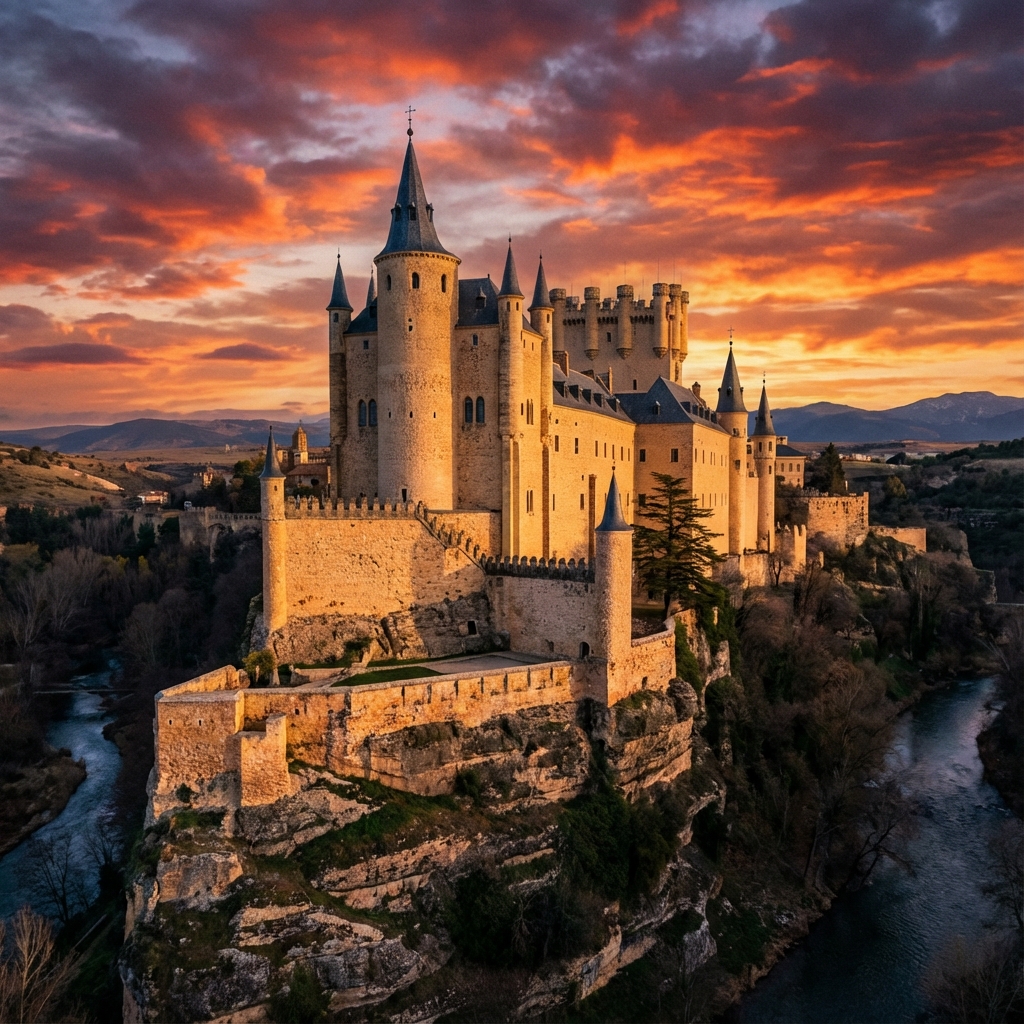
The Alcázar of Segovia is one of the most distinctive castle-palaces in Spain and Europe. Rising out on a rocky crag above the confluence of the Eresma and Clamores rivers, its unique shape resembles the bow of a ship cutting through the landscape. Along with the Roman Aqueduct and the Cathedral, it forms the heart of Segovia's UNESCO World Heritage site.
History: From Roman Fort to Royal Palace
The site has been fortified since Roman times, but the current structure began to take shape as a fortress during the 12th century under the Berber Almoravid dynasty and later the Christian kings.
- Royal Residence: During the Middle Ages, the Alcázar was a favorite residence of the monarchs of the Kingdom of Castile. It was here that Isabella I was proclaimed Queen of Castile in 1474, a pivotal moment in Spanish history.
- The 1862 Fire: A devastating fire in 1862 destroyed much of the upper structure. The castle was rebuilt in a romantic style, adding the distinctive slate spires that give it its fairy-tale appearance today—often cited as an inspiration for Walt Disney's Cinderella Castle.
- Diverse Uses: Over the centuries, it has served as a royal palace, a state prison, a Royal Artillery College, and now a museum and military archive.
Architecture & Interiors
The Alcázar is a masterpiece of Mudejar architecture, blending Christian and Moorish artistic styles.
- The Tower of John II: The tallest tower, formerly a state prison, stands 80 meters high. Its walls are decorated with 'sgraffito' patterns, a technique common in Segovia.
- Hall of the Galley (Sala de la Galera): Named for its incredible Mudejar ceiling, which is shaped like the inverted hull of a ship.
- Hall of Kings (Sala de los Reyes): This grand room features a frieze depicting 52 seated statues of the Kings and Queens of Asturias, León, and Castile, ending with Joanna the Mad.
- The Armory: Displays a collection of medieval armor and weaponry, reflecting the castle's military heritage.
Visitor Tips
- Best View: For the iconic photo of the "ship" shape, head down to the park in the valley below, known as the Pradera de San Marcos.
- Climb the Tower: You can climb the 152 steps of the Tower of John II for spectacular panoramic views of Segovia and the Sierra de Guadarrama mountains. Note that there is no elevator.
- Combine Your Visit: Segovia is a compact city. The Roman Aqueduct is just a 15-minute walk away through the charming old town.
Frequently Asked Questions
- Is it accessible for wheelchairs?
- The ground floor of the palace (Museum rooms) is accessible, but the Tower of John II is not. There are reduced ticket prices for visitors with disabilities.
- How do I get there from Madrid?
- Segovia is an easy day trip from Madrid. The high-speed AVANT train takes only 27 minutes. From the station, a short bus ride takes you to the Aqueduct.
- Is it open every day?
- Yes, the Alcázar is open daily, though hours vary slightly by season. It closes on some holidays like Christmas and New Year's Day.