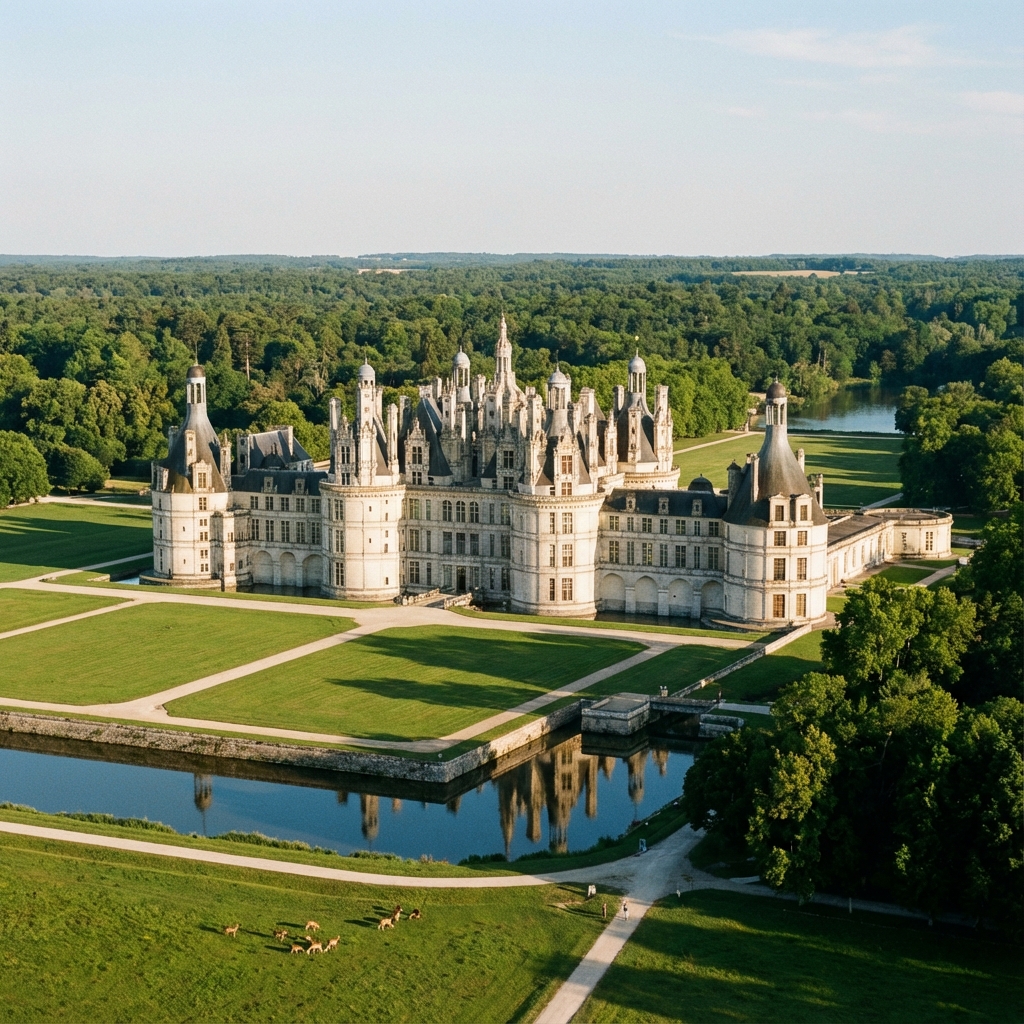
Château de Chambord is the largest and most majestic château in the Loire Valley. A symbol of the French Renaissance, it was built to serve as a hunting lodge for Francis I, though he spent very little time there. The castle is a UNESCO World Heritage site and an architectural wonder that blends traditional French medieval forms with classical Renaissance structures.
History: A Royal Dream
Construction began in 1519, a year of significant change with the death of Leonardo da Vinci. The original design is attributed to the Italian architect Domenico da Cortona, but there is strong evidence that Leonardo da Vinci influenced the plans, particularly the central staircase.
Work was interrupted by the Italian War of 1521–1526 and slowed by dwindling royal funds. King Francis I wanted Chambord to look like the skyline of Constantinople. It was never intended as a permanent residence; the king only stayed here for a total of 72 days during his reign. The castle was left unfinished at his death but was later continued by his son Henry II and finally completed by Louis XIV in the 17th century.
Architecture: The Double-Helix Staircase
The architectural highlight of Chambord is the double-helix staircase located in the center of the keep. It consists of two intertwining spiral ramps that ascend three floors without ever meeting. This allowed people to go up and down simultaneously without crossing paths—a brilliant design often attributed to Da Vinci.
The château is vast, featuring:
- 440 rooms and 84 staircases.
- 282 fireplaces, essential for heating the massive stone structure.
- The Roof Terrace: A unique promenade offering panoramic views of the estate, surrounded by a forest of lanterns, chimneys, and dormer windows.
- The Salamander: King Francis I's emblem, the salamander (believed to endure fire), is carved over 700 times throughout the castle.
The Park & Gardens
Chambord is situated in the heart of the largest enclosed forest park in Europe. The estate covers 5,440 hectares (about the size of inner Paris) and is surrounded by a 32-kilometer wall. It remains a sanctuary for wild boars and deer.
In 2017, the formal French Gardens were restored to their 18th-century glory, offering a stunning geometric perspective from the castle terraces.
Visitor Tips
- Rent a bike: The grounds are too vast to explore fully on foot. Bicycles and electric carts are available for rent.
- Attend a show: In the summer, the stables host a magnificent horse and bird of prey show.
- Climb to the top: The view of the intricate roof architecture from the terrace is unmissable.
Frequently Asked Questions
- Did Leonardo da Vinci design Chambord?
- While there is no written proof, his influence is undeniable. He was the King's guest at nearby Clos Lucé, and sketches in his notebooks resemble the double-helix staircase and the castle's Greek cross layout.
- Is the castle furnished?
- Yes, over the years, many rooms have been refurnished to represent different eras, from the Renaissance travels of Francis I to the 18th-century apartments of Marshal Saxe.
- How much time does a visit take?
- To see the castle, the gardens, and the stables, plan for a half-day trip (3-4 hours). If you want to explore the forest trails, you could easily spend the whole day.
- Is it wheelchair accessible?
- The ground floor is accessible, but the upper floors and the famous staircase are difficult for those with reduced mobility. However, a digital tablet guide is available to virtually visit the inaccessible areas.