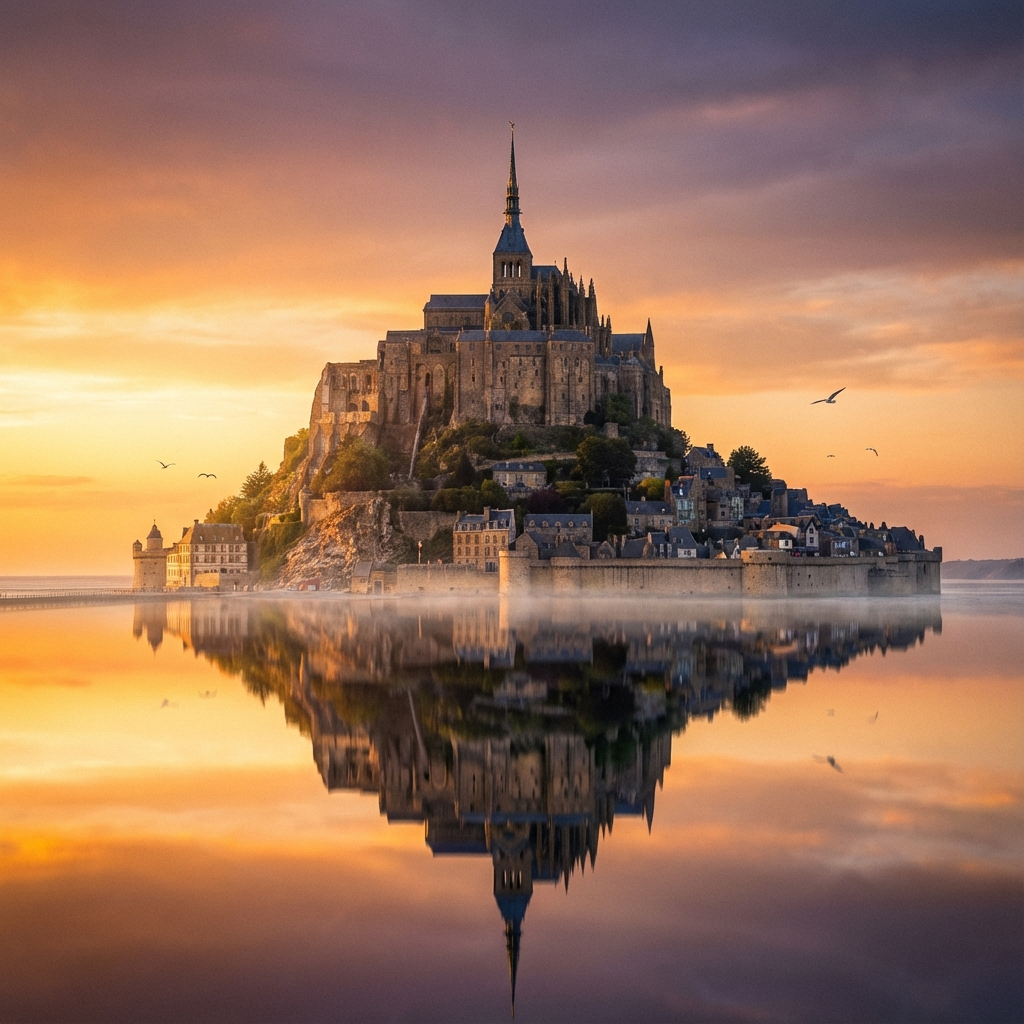
Mont Saint-Michel is a tidal island and mainland commune in Normandy, France. Rising dramatically from the sea like a mirage, the island lies approximately one kilometer off the country's northwestern coast at the mouth of the Couesnon River. It is visited by more than 3 million people each year and is widely known as the "Wonder of the Western World."
History: From Dream to Dungeon
The history of Mont Saint-Michel begins in 708 AD, when Bishop Aubert of Avranches claimed that the Archangel Michael pressured him to build a church on the rocky islet. According to legend, the Archangel burned a hole in Aubert's skull with his finger because he wouldn't pay attention.
In 966, a community of Benedictine monks settled on the rock and built a pre-Romanesque church. Over the centuries, the abbey became a major pilgrimage destination and a center of medieval culture.
- The Hundred Years' War: The mount turned into a formidable fortress. Protected by its ramparts and the tides, it successfully resisted a 30-year siege by the English, becoming a symbol of French national identity.
- The Bastille of the Seas: During the French Revolution, the abbey was closed and converted into a prison for political opponents. It remained a prison until 1863.
The Architecture: The Marvel (La Merveille)
The structural composition of the town exemplifies the feudal society that constructed it. On top, God, the abbey, and monastery; below this, the great halls, then stores and housing; and at the bottom (outside the walls), fishermen and farmers' housing.
The masterpiece of the complex is the Gothic section built in the 13th century on the north side, known as La Merveille. It is a feat of engineering, featuring the Knights' Hall and a stunning cloister suspended high above the sea.
The Spire: The neo-Gothic spire was added in 1897. At its very tip sits a gilded statue of Saint Michael slaying a dragon, serving as a lightning rod and a beacon.
The Tides and the Bay
Mont Saint-Michel is famous for having the highest tides in continental Europe (up to 15 meters difference between low and high tide). Victor Hugo described the incoming tide as advancing "as swiftly as a galloping horse." While this is an exaggeration, the water does rise rapidly.
In 2014, a new bridge was opened to replace the old causeway, allowing the waters to flow freely around the island again and restoring its maritime character. Several times a year, during the "super tides," the mount becomes completely surrounded by water.
Visiting Mont Saint-Michel
Walking through the medieval village feels like stepping back in time.
- La Grande Rue: The main street is lined with stone houses, souvenir shops, and restaurants. It is often crowded, so try to visit early in the morning or late afternoon.
- La Mère Poulard: Famous since 1888, this inn is renowned for its giant, fluffy omelettes cooked over an open fire. It's a culinary institution, though pricey.
- Bay Walks: At low tide, you can walk on the sand around the island. Warning: Never venture far without a certified guide, as the bay is known for dangerous quicksand and rapidly rising tides.
Frequently Asked Questions
- Is there an awful lot of climbing involved?
- Yes. The village is steep and there are many stairs (about 350 steps) to reach the Abbey at the top. It is difficult for those with limited mobility.
- Where do I park?
- Visitors must park in the designated mainland car parks (2.5 km away). From there, you can take the free shuttle bus (Le Passeur), a horse-drawn carriage (extra cost), or walk (about 40 minutes).
- Can I bring my luggage?
- No. For security reasons and due to the steep terrain, large luggage is not allowed in the shuttle or the monument. There are no lockers on the island.