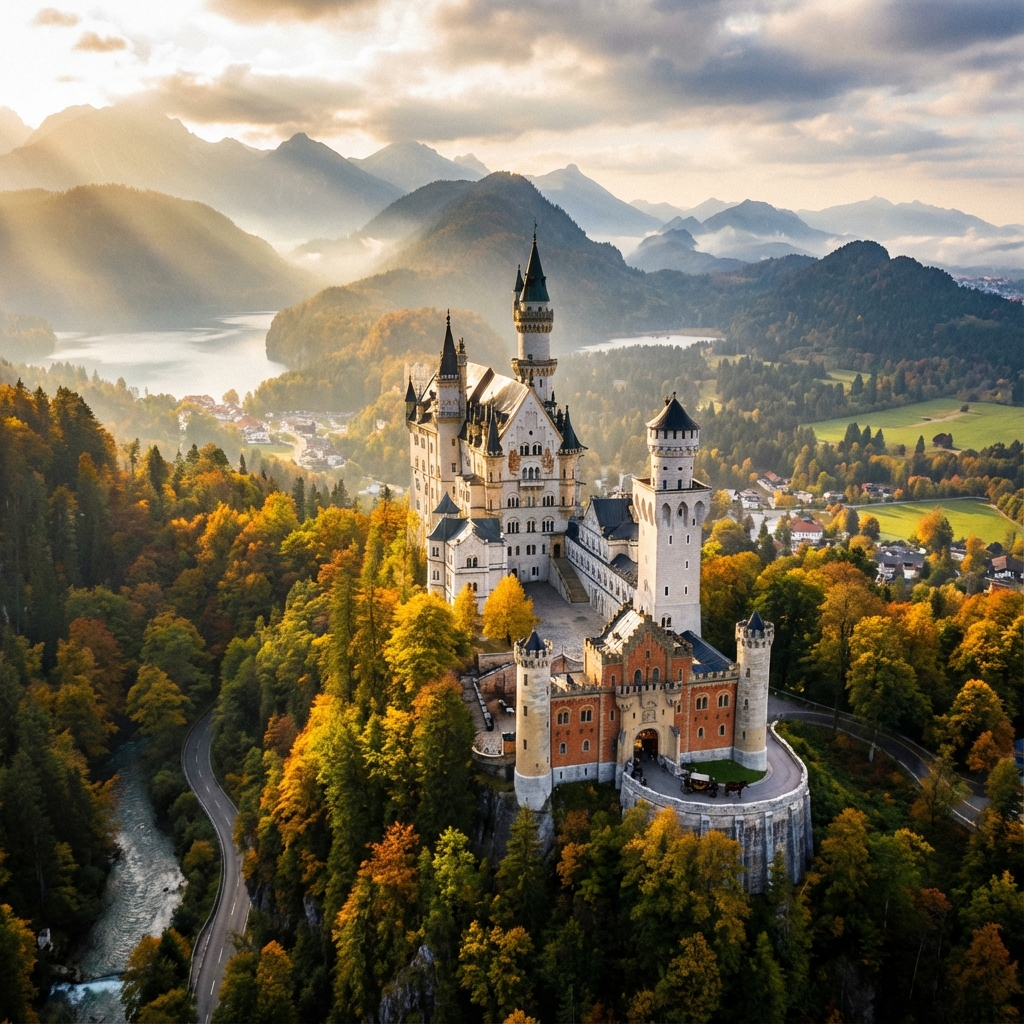
Neuschwanstein Castle (Schloss Neuschwanstein) is a 19th-century historicist palace situated on a rugged hill above the village of Hohenschwangau near Füssen in southwest Bavaria, Germany. It is one of the most popular castles in Europe and the quintessential "fairytale castle" that inspired Walt Disney's Cinderella and Sleeping Beauty castles. As a global icon of Romanticism, it is currently a candidate for UNESCO World Heritage status (decision expected in 2025) as part of the "Palaces of King Ludwig II" ensemble.
History of Neuschwanstein: The Dream of a King
The palace was commissioned by King Ludwig II of Bavaria, often called the "Fairytale King" or "Mad King Ludwig," as a private retreat and a monumental homage to the composer Richard Wagner. Ludwig paid for the palace out of his personal fortune and extensive borrowing, rather than Bavarian public funds.
Construction began in 1869, but the sheer scale of the project meant it was never fully completed. Ludwig only slept 11 nights in the castle before his mysterious death in 1886. Originally known as "New Hohenschwangau Castle," it was renamed Neuschwanstein ("New Swan Stone") after his death. Paradoxically, the castle built for a shy hermit was opened to the public just seven weeks after he died. Since then, over 61 million people have visited.
Construction & Technology: Medieval Look, Modern Core
While Neuschwanstein was designed to look like a medieval knight's fortress, it was actually a marvel of modern 19th-century technology. The King demanded the latest comforts, which were concealed behind the historicist facade.
- Central Heating: A hot air heating system kept the large rooms warm.
- Running Water: Every floor had running water, and the kitchen had hot and cold water.
- Automatic Flushing: The toilets featured an automatic flushing system, a rarity for the time.
- Electric Call System: A battery-powered bell system allowed the King to summon servants.
- Telephone: There was even a telephone line connecting the castle to the older Hohenschwangau Castle.
- Industrial Construction: Steam cranes and steel structures were used to build the castle on the difficult cliffside terrain.
Myths, Legends & Richard Wagner
Neuschwanstein is a temple to the operas of Richard Wagner. The architecture and interior murals vividly depict scenes from Germanic sagas that Wagner adapted. The Swan is a recurring motif throughout the castle, representing the "Swan Knight" Lohengrin—a character Ludwig identified with deeply—and the heraldic animal of the Counts of Schwangau.
- The Singers' Hall: This massive hall, adorned with scenes from the legend of Parzival and the Holy Grail, was never used for concerts in Ludwig's time. It was a monument to the culture of medieval knights and courtly love.
- The Throne Hall: Inspired by Byzantine churches, this two-story hall features a 4-meter tall chandelier and a mosaic floor depicting the animal kingdom. Notably, there is no throne; the King died before one could be installed.
- The Artificial Grotto: Between the Salon and the Study lies a man-made stalactite cave with a waterfall, originally illuminated by colored electric lights to evoke the Venus Grotto from Wagner's Tannhäuser.
Visiting Neuschwanstein: A Seasonal Guide
Neuschwanstein offers a different experience depending on when you visit.
Summer (May - September)
This is the peak season. The surrounding forests are lush green, the lakes are blue, and all hiking trails are open. However, crowds are at their highest (up to 6,000 visitors per day). Tip: Book tickets weeks in advance and arrive early to avoid long queues at the shuttle bus.
Winter (November - March)
The castle transforms into a true winter wonderland when covered in snow. The atmosphere is quieter and more magical. Warning: The Marienbrücke (Mary's Bridge) is often closed due to ice and snow, meaning the classic photo view might be inaccessible. The Pöllat Gorge trail is also usually closed.
The Surroundings: More Than Just One Castle
Don't rush your visit; the region of Schwangau has more to offer.
- Hohenschwangau Castle: The yellow neo-Gothic castle on the neighboring hill where Ludwig grew up. It is fully furnished and feels more lived-in than Neuschwanstein.
- Museum of the Bavarian Kings: Located by the Alpsee, this modern museum explains the history of the Wittelsbach dynasty and Ludwig's life.
- Alpsee Lake: One of the cleanest lakes in Germany. You can rent rowboats or walk the circular trail (approx. 1.5 hours) for stunning views of both castles from below.
Essential Visitor Information
Opening Hours
- April to 15 October: 9 am - 6 pm
- 16 October to 31 March: 10 am - 4 pm
- Open daily except January 1, and December 24, 25, 31.
Getting There & Logistics
The castle is located near Füssen.
- Tickets: Must be bought online via the official ticket shop. Do not go to the castle without a ticket if you want a tour; they sell out quickly.
- Access: Private cars cannot drive to the castle. You must park in Hohenschwangau (P1-P4) and then walk (40 mins), take the horse carriage, or the shuttle bus.
- Tours: Entry is only by guided tour (35 mins). Audio guides are available in 16 languages.
Frequently Asked Questions
- Is Neuschwanstein Castle worth the hype?
- Yes. Despite the crowds, the combination of architectural daring, tragic history, and Alpine scenery is unmatched.
- How long does the tour take?
- The guided tour itself takes about 35 minutes, but plan for 3-4 hours for the whole experience (parking, getting up the hill, photos, and getting down).
- Can I take photos inside?
- No, photography and filming are strictly forbidden inside the castle to protect the interiors.
- Is the Marienbrücke open?
- It is open most of the year but closes during bad weather in winter. Check the daily status at the ticket center.